
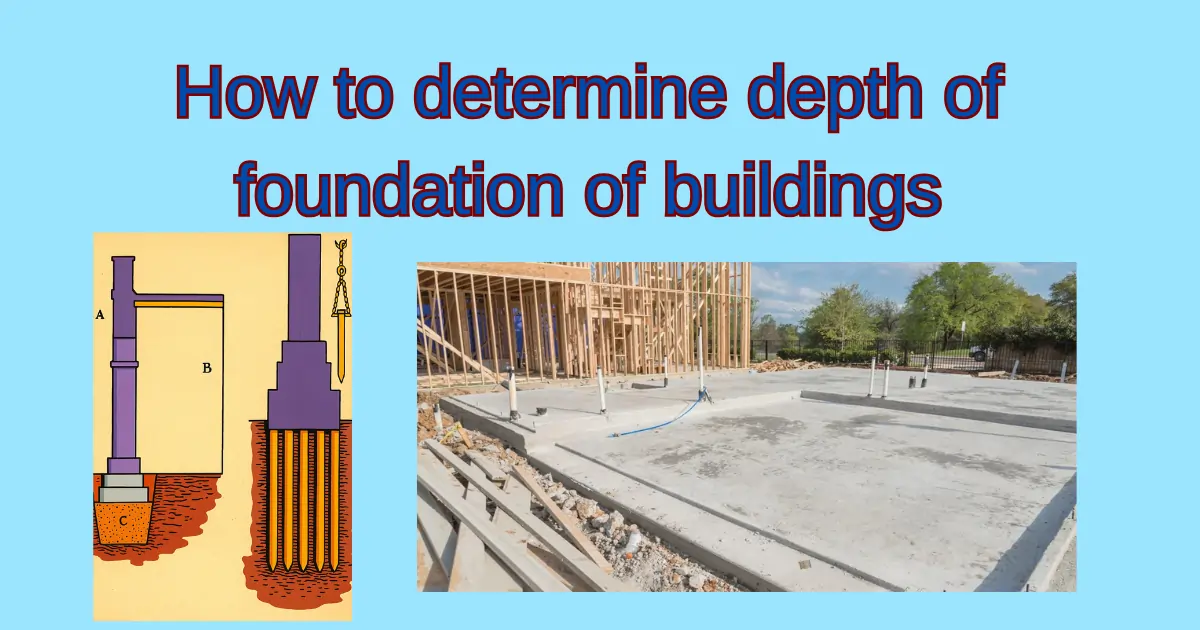
Choosing the correct foundation depth is one of the most critical decisions in residential construction, directly impacting the structural integrity, safety, and longevity of a building. The foundation depth must be carefully determined based on multiple interconnected factors including soil conditions, building characteristics, environmental considerations, and local building codes.
The selection of foundation depth is dependent on several factors that include the types of soils and several factors that influence behavior of the soil under various circumstances.
The design professional starts the process of foundation depth determination from the types of the building and the actual site conditions. The building regulations guide the process to ascertain that a safe and acceptable design procedure is followed. The final decision of the depths lie up on the design professional that is responsible for the project.
The various regulations and codes recommend minimum depths and widths for various types of soil and environmental conditions.
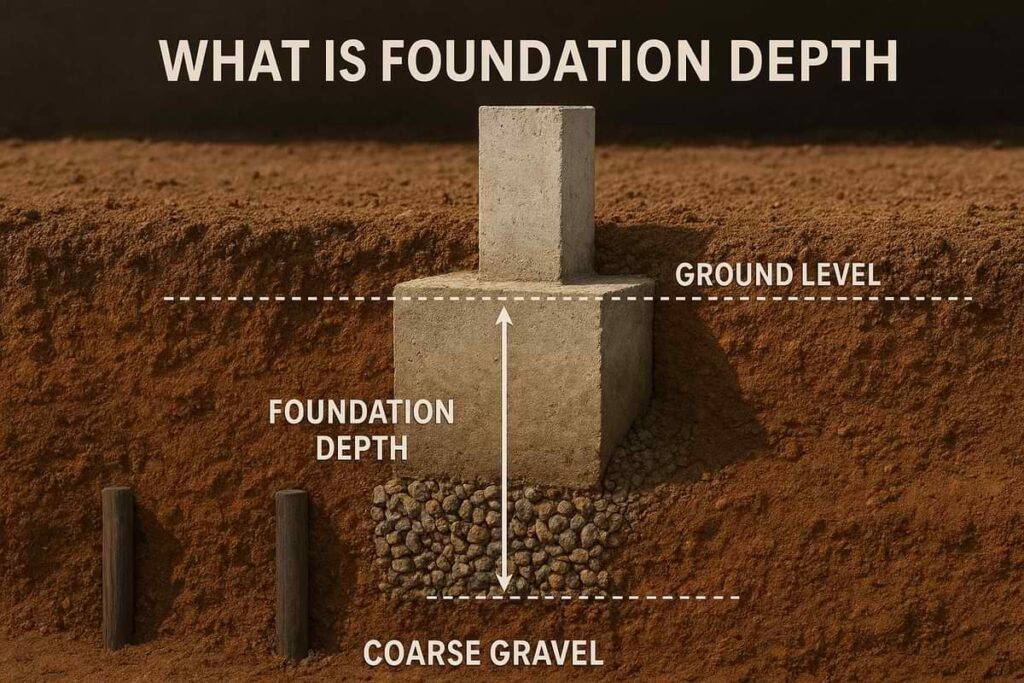
What is foundation depth
The depth of the foundation is the height measured from the ground level to the bottom most side of the foundation and if a coarse gravel was used as a capillary break layer under it that is also counted as part of the foundation depth.
For piles and pillars the foundation depth is measured from the top ground level to the lowest level of the soil they are placed on.
Primary Factors Affecting Foundation Depth
The depth of foundation is selected considering the various factors that are necessary for ensuring a stable and firm foundation and a design that is compliant with building codes.
The governing depth from the several factors can be frost depth for some places like cold regions of Canada and Sweden. But it can also be the minimum depth requirement that is set by codes for other warm regions.
The water table, trees and proximity to existing buildings can also affect the depth of the foundation.
The ultimate purpose of selecting a suitable depth is so that the foundation supports the loads and the soil has sufficient bearing capacity. The bearing capacity of the soil is the main factor that is considered in designing a foundation.
Hence, determining foundation depth involves multiple factors and intelligent analysis of those factors is taken to arrive at a depth that can adequately support the building loads.
Soil Type and Bearing Capacity
When selecting the depth of a foundation, the type of soil plays a big role because the goal is to place the foundation where:
- The soil has enough bearing capacity to support the load.
- The soil is stable and not prone to excessive settlement, shrinkage, swelling, or erosion.
- Seasonal changes (like frost or moisture variation) won’t cause movement.
Therefore, the type of soil beneath a structure is the main factor determining foundation depth requirements. In addition the environmental conditions of a site also affect the foundation depth since certain types of soils bearing capacity varies with exposure for frost,moisture and water table fluctuations.
Different soil types have vastly different load-bearing capacities . The effect of environmental conditions on the load bearing capacity of soils also depends on the types of soils. Hence the bearing capacity plays the most important role in selection of the type and how deep foundations must be placed.
Clay Soils require the deepest foundations, typically 0.9 to 1.5 meters or more. Clay soils are particularly challenging because they expand and contract significantly with moisture changes, potentially causing structural movement if foundations are too shallow. The volume changes accompanying their expansive nature means foundations must extend below the zone of seasonal moisture variation called active zone,
The bearing capacity values for clay soils vary significantly based on consistency manly because of moisture content. Soft clays exhibit bearing capacities below 75 kPa, while firm clays range from 75-150 kPa, and stiff clays provide 150-300 kPa. Very stiff clays and hard clays can achieve bearing capacities of 300-600 kPa. However, these values must be considered alongside the expansive nature of clay soils.
According NHBC standard of UK expansive soils are classified according to their plasticity and the depth of foundation is recommended to each category.
Shrinkable soils are classified as containing more than 35% fine particles (clay and silt) and have a Modified Plasticity Index of 10% or greater.
Sandy and Gravel Soils offer better stability and drainage, allowing for shallower foundations typically ranging from 0.6 to 0.9 meters. These soils provide good load distribution and are less susceptible to moisture-related volume changes.However, the specific bearing capacity must still be determined through soil testing.
Silt Soils fall between clay and sand in terms of requirements, typically requiring foundation depths of 0.75 to 1.0 meters. Silt can be frost-susceptible, requiring additional depth considerations in cold climates.
Rock Substrates provide the highest bearing capacity and may allow for the shallowest foundations, typically 0.45 to 0.6 meters, provided the rock is competent and not subject to weathering or frost action.
Type of soils where a specific minimum depth is mandatory
For certain soils, you must place the foundation below the zone of seasonal moisture change or frost penetration to avoid movement. This includes:
- Expansive clays (e.g., black cotton soil)
- These shrink in dry seasons and swell in wet seasons.
- Foundation must be placed below the active zone (often >1.5–3 m in severe cases).
- Frost-susceptible soils (silts, fine sands, certain clays in cold climates)
- Must go below frost line (varies by climate, can be 0.5–3 m).
- Loose sands or uncompacted fills
- Must go deep enough to reach dense, compact, natural strata.
- Organic soils / peat
- Generally avoided; if unavoidable, depth should reach firm strata beneath.
Type of soils where depth requirement is less strict
If the top layer is naturally stable, non-expansive, and has adequate bearing capacity, the depth can be minimal (still following code minimums, usually ≥0.5 m for shallow footings):
- Gravelly soils
- Well-graded coarse sands
- Hard murrum
- Rock
In these soils, the main depth requirement is often just enough to:
- Avoid topsoil/vegetative layer
- Protect against scour/erosion
- Ensure footing is in undisturbed soil
Building Size and Load Requirements
The structural demands of the building significantly influence foundation depth requirements. There is no one size fit all regarding depth of foundations for buildings. However, Heavier and multi story structures require deeper foundations to distribute loads effectively and prevent settlement.
Environmental and Climate Considerations
Frost Line Protection
In regions subject to freezing temperatures, foundations must extend below the frost line to prevent frost heave damage. The frost line is the depth to which ground typically freezes during winter months.
This is crucial in very cold regions like Sweden where I live and Canada. Thus in those cold regions it is a major factor in deciding the depth the foundation. In sweden the depth of foundation is guided by a foundation depth map that covers all regions in the country.
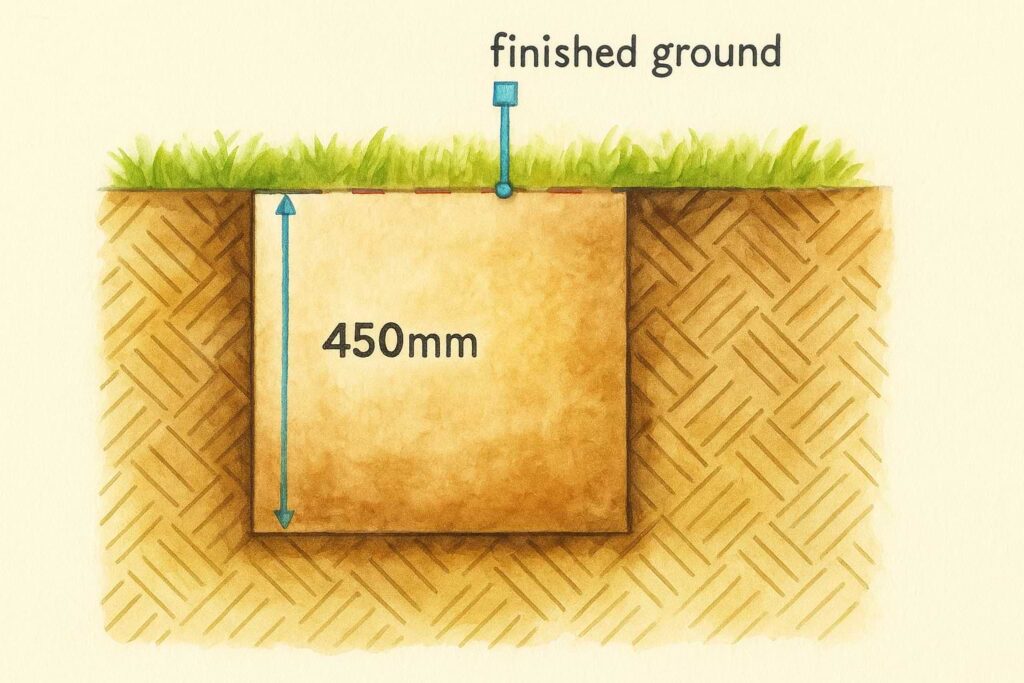
In UK, Minimum Frost Protection requires foundations to be placed at least 450mm below the frost line in frost-susceptible soils. This prevents the expansion of freezing water from lifting or damaging the foundation.
In the USA frost line depth is decided by local jurisdictions although IBC and IRC provide recommendations.IBC Section 1809.4 requires a minimum depth of 12 inches for footings below the undisturbed ground surface but it is not mandatory.
The ASCE 32-01 standard provides guidelines on how to construct in frost prone regions. The standard recommends the frost depth for regions over all of the USA and for construction categories of heated, unheated buildings and for insulated footings construction.
How is foundation depth in frost prone areas is determined for buildings
In Sweden where I live, regional variations in frost line depth are significant. For example, Mälmo in Sweden has 1.1m as it is the warmest. The coldest region kiruna has 2.5m and Stockholm has 1.6m.
However the frost free depth is nowadays in Sweden being reduced to buildings that are warmed up all the year. For example for residential housing that has heat protection isolation the depth of 0.35 m is allowed for houses warmed above 18 degree centigrade all the time.
If the temperature of un warmed buildings like under ground storage, garages are above 0 degree centigrades, the depth can be reduced by a factor less than the actual depth. For 0 degrre centigrade by 0.6;and for 10 degree centigrade by 0.3.
However for other open buildings which are not warmed the frost free depth is taken as depth of the foundation.
Geotechnically speaking frost depth is only a design concern for soils that are frost-susceptible, not for all soils. Hence engineers must decide if the soil is affected by frost or not by conducting soil tests.
Frost-susceptible soil are typically fine-grained soils like silts, silty sands, and certain clays that can hold water in capillaries
Frost depth usually not a concern for gravel and coarse sands -with large voids, little capillary rise-,Solid rock, or well-drained soils with no water source
In those non-susceptible soils, foundations don’t have to be below frost depth, though codes still require a minimum embedment for stability and erosion resistance.
Water Table Considerations
The groundwater level significantly affects foundation design and depth requirements. High water tables present multiple challenges including reduced soil bearing capacity, potential for foundation movement due to soil moisture changes, and increased risk of basement flooding.
The bearing capacity of friction soils decreases in high water table scenarios because the effective stress gets reduced. This in turn results in less shear strength. For clay soils the reduction occurs in long term due to the water dissipation takes long time.This may necessitate wider foundations or deeper placement to reach more competent bearing layers
High Water Table Scenarios may require foundations to be placed above the water table when possible, or require extensive waterproofing and drainage systems when foundations must extend below groundwater levels. One method is to use a gravel raft using a sump to drain the water away from the excavation to construct in high water table scenarios.
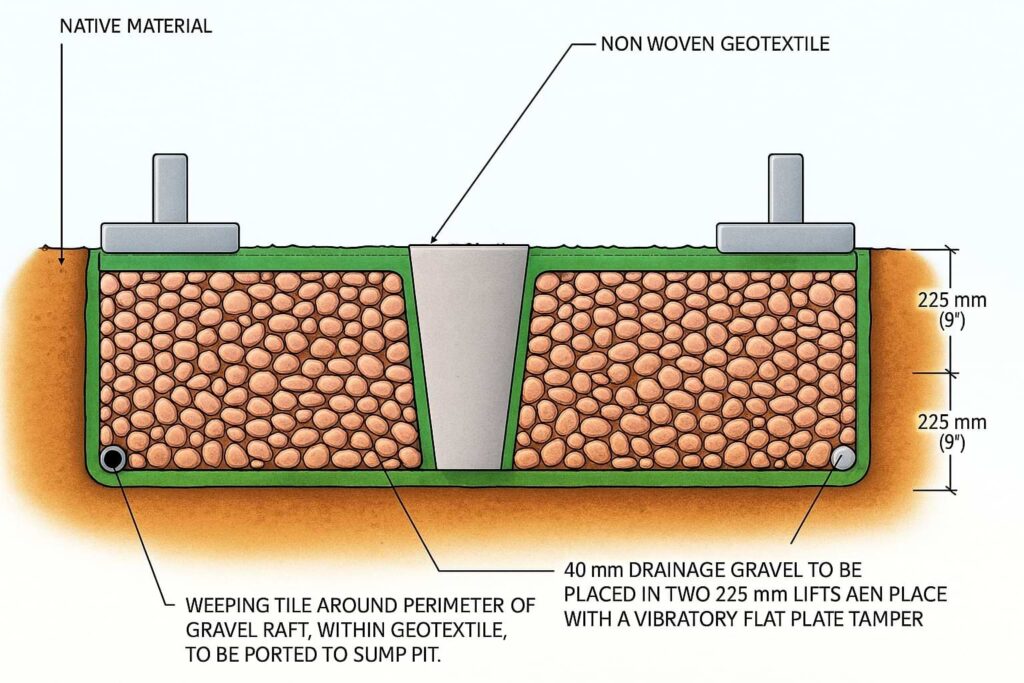
Construction in high water table areas has the disadvantage that it often requires continuous pumping during excavation and specialized waterproofing techniques.
It is necessary to make sure that the water table does not fluctuate above and below the foundation. In sands, fluctuating water table reduces shear strength and may cause settlement. In clays, fluctuating water table causes swelling/shrinkage cycles that damage structures.
Tree Proximity Effects
Trees significantly impact foundation depth requirements through their root systems and their effect on soil moisture content. Large trees can cause soil shrinkage during dry periods and expansion during wet periods, particularly in clay soils.

Distance-Based Requirements specify minimum foundation depths based on tree proximity according to the sphere of influence of the types of the trees. The depth of foundation depends on the distance of the tree from the foundation edge, the height of the tree, the water demand of the tree and the potential for volume change of the soil.
Example for tree with high water demand and high volume change potential of soil
- Trees 8m high within 5 meters: Minimum 2.25m foundation depth
- Trees 8m high and 10 meters away: Minimum 1.0m foundation depth
- Trees 10m high and 20 meters away: Minimum 2.5 m foundation depth
- Trees 20m tall and 20 meters away: Minimum 1.50m foundation depth
Large trees that require more depth than 2.5m requires engineering design.
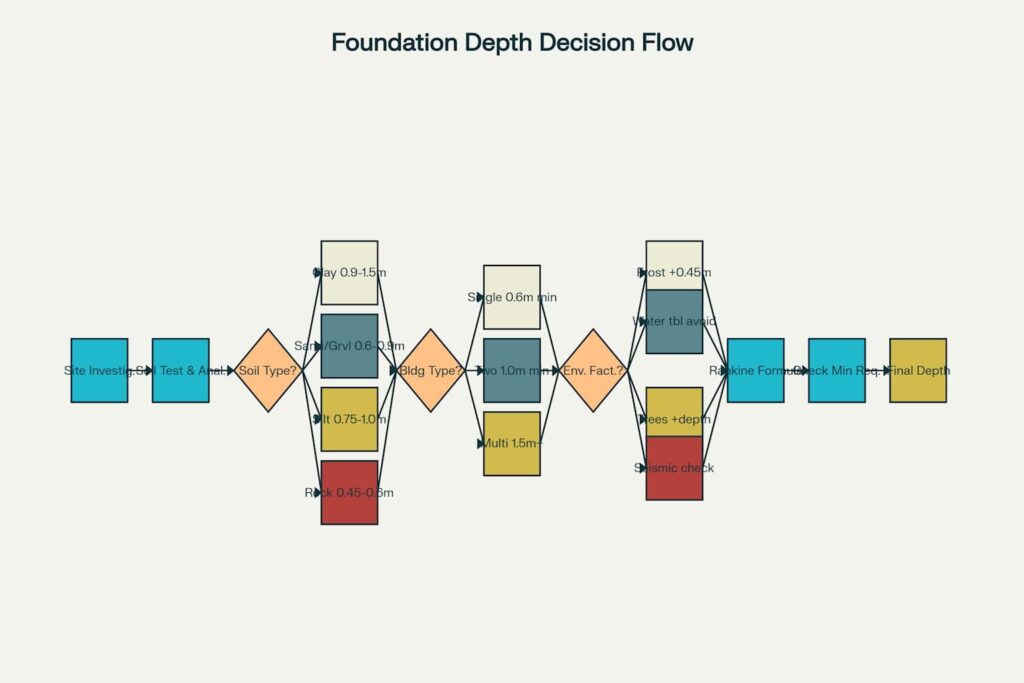
Foundation Depth Determination Decision Flowchart
Seismic Considerations
In earthquake-prone areas, foundation depth must account for seismic forces and soil liquefaction potential. Seismic design affects foundation requirements through ground motion amplification, soil-structure interaction, and liquefaction risk.
Liquefaction Potential analysis is mandatory for tall buildings in seismic zones, as liquefiable soils may require foundations to extend to non-liquefiable layers or require ground improvement techniques.
Foundation Depth Calculation Methods
Approximate estimation using Rankine’s Formula
The most widely used equation for rough estimation of minimum foundation depth is Rankine’s formula:
D = P/γ [(1-sinθ)/(1+sinθ)]²
Where:
- D = depth of foundation
- P = applied pressure
- γ = density of soil
- θ = angle of repose of soil
Accurate depth estimation by Geotechnical Investigation
Comprehensive site investigation is fundamental to proper foundation depth determination. The relevant soil tests should be carried out to classify the soil type, estimate the bearing capacity and study the effects of the environmental conditions of the site.The investigation must assess:
Soil Properties:
- Bearing capacity and shear strength parameters
- Soil classification and stratification
- Groundwater conditions and seasonal variations
- Potential for settlement and consolidation
Environmental Factors:
- Frost line depth and seasonal temperature variations
- Seismic conditions and earthquake considerations
- Potential for expansive or collapsible soils
Standard Investigation Methods
Professional site investigation can be required for accurate foundation depth determination. The most common soil investigation tests include:
Field Testing:
- Standard Penetration Test (SPT) for soil density and strength
- Cone Penetration Test (CPT) for continuous soil profiling
- Test pits for direct soil observation and sampling
Laboratory Testing:
- Soil classification tests (grain size, Atterberg limits)
- Strength testing (triaxial, direct shear)
- Consolidation and compressibility testing
Minimum Code Requirements
The building codes that guide construction also set minimum requirements that should be followed even when the other requirements are met. The requirements make sure to avoid the placement of the foundation at a soil layer that is not desirable. This is to avoid organic soils, vegetative cover etc
Building codes prescribe absolute minimum depth requirements to avoid the organic soil situated at the top of the ground, frost depth and specific local needs. The absolute minimum depth should be increased based on specific site conditions.
The IBC International Building Code (IBC) requirement states any foundation should have at least 2 inches (305 mm) below undisturbed ground surface. The foundation depth must also fulfill frost depth requirements of the locality.
Further, foundations must bear on undisturbed soil, compacted fill material, or controlled low-strength material (CLSM)
The ASCE 32-01 standard provides guidelines on how to construct in frost prone regions. The standard recommends the frost depth for regions over all of the USA and for construction categories of heated, unheated buildings and for insulated footings construction.
According to IBC Chapter 18, Section 1809.5, if it is confirmed that the soil is prone for frost,the foundation depth should be lower than the frost line depth, or precautionary measures should be taken according to the standard or the building should be constructed or rock. Building on frozen ground is not acceptable unless the frozen condition is permanent.
Adjacent Structure Considerations
When building near existing structures, foundations must be placed at appropriate depths to prevent undermining adjacent buildings.
General Practice requires excavating to at least the same depth as the bottom of foundations of adjacent buildings to prevent undermining. This may require significantly deeper excavations than would otherwise be necessary.
Setback Requirements from property lines and adjacent structures may also influence foundation depth and design, particularly on sloping sites or in dense urban areas.
Utilities and Services
Underground utilities significantly impact foundation depth and placement. Foundations must maintain appropriate clearances from water lines, sewer systems, gas lines, and electrical utilities.
The foundation may also be necessary to be placed so that the house’s plumbing lines lay below the municipality lines to avoid flow problems.
Sloping Sites
On sloping sites, foundation depth requirements become more complex due to slope stability considerations and varying ground levels.
Stepped Foundations may be required to maintain minimum depths for frost depth and stable soil layer while following slope contours. The stability of the slope itself must be analyzed to ensure foundations do not compromise overall site stability.