
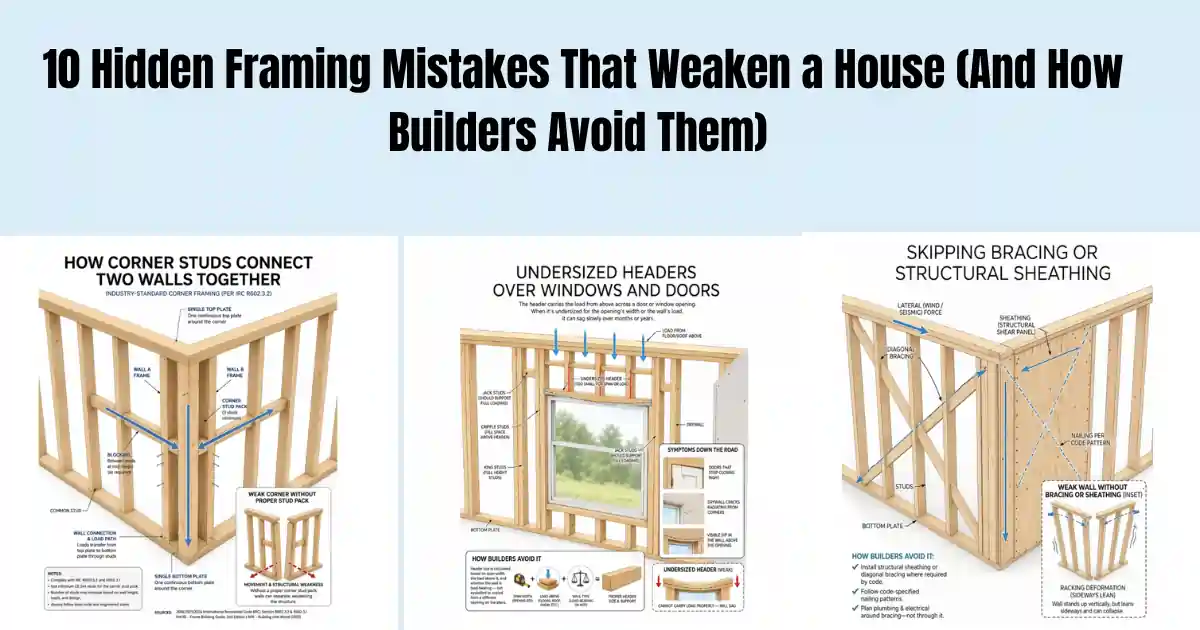
Framing mistakes are some of the sneakiest problems in home construction. They’re invisible once the drywall goes up, they rarely cause obvious symptoms right away, and by the time you notice — a sagging header, a cracking corner, a bouncy floor — the fix usually means opening up a wall.
The good news: every one of these mistakes has a known cause and a known fix. Here are 10 of the most common (and most costly) framing errors, and how experienced builders avoid them.
1. Weak or Missing Corner Studs
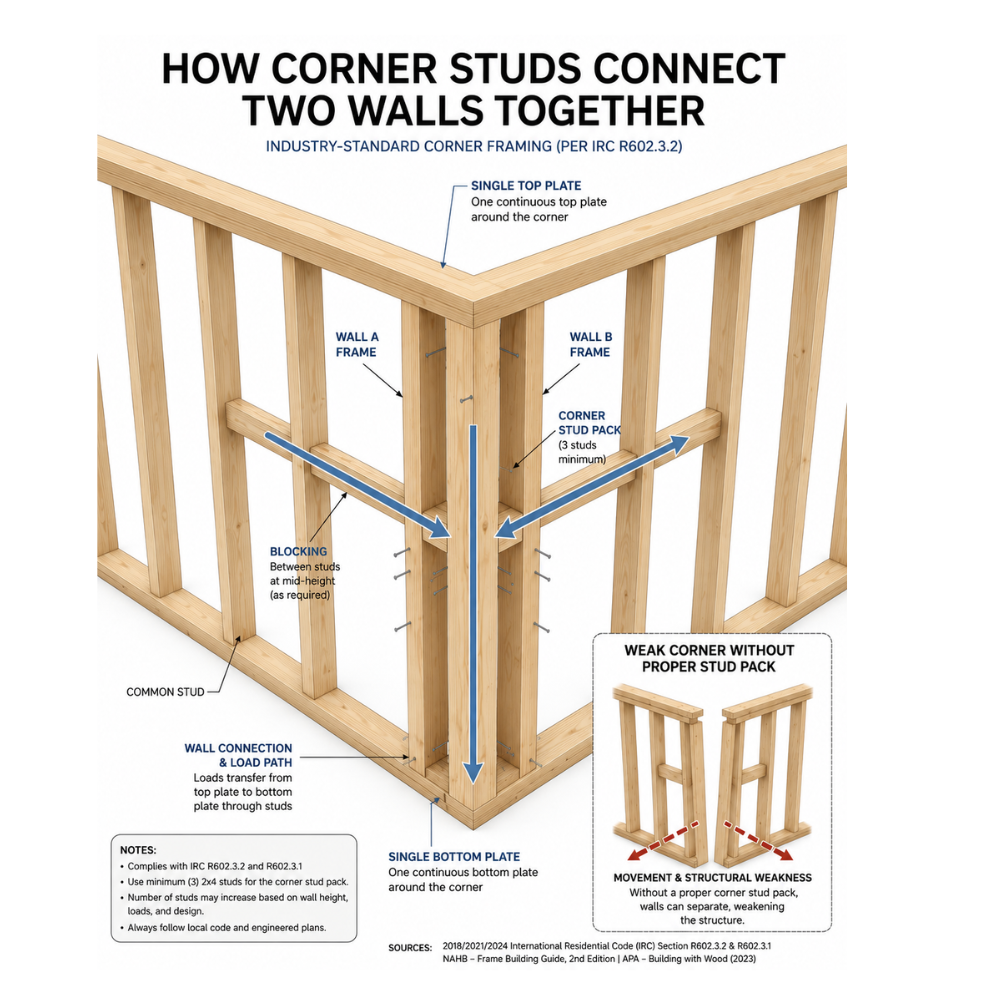
Exterior corners are where two walls have to act as one continuous structure. When builders skip a proper corner stud pack — using just two studs with no blocking or connection between them — the corner has no real load path and nothing solid for drywall to attach to on the inside.
How builders avoid it: A correctly built corner uses multiple studs (often three or more) tied together with blocking, plus overlapping top plates that lock both walls’ framing together at the top. Refer IRC R602.3.5 Corner Studs and local code requirement
2. Undersized Headers Over Windows and Doors
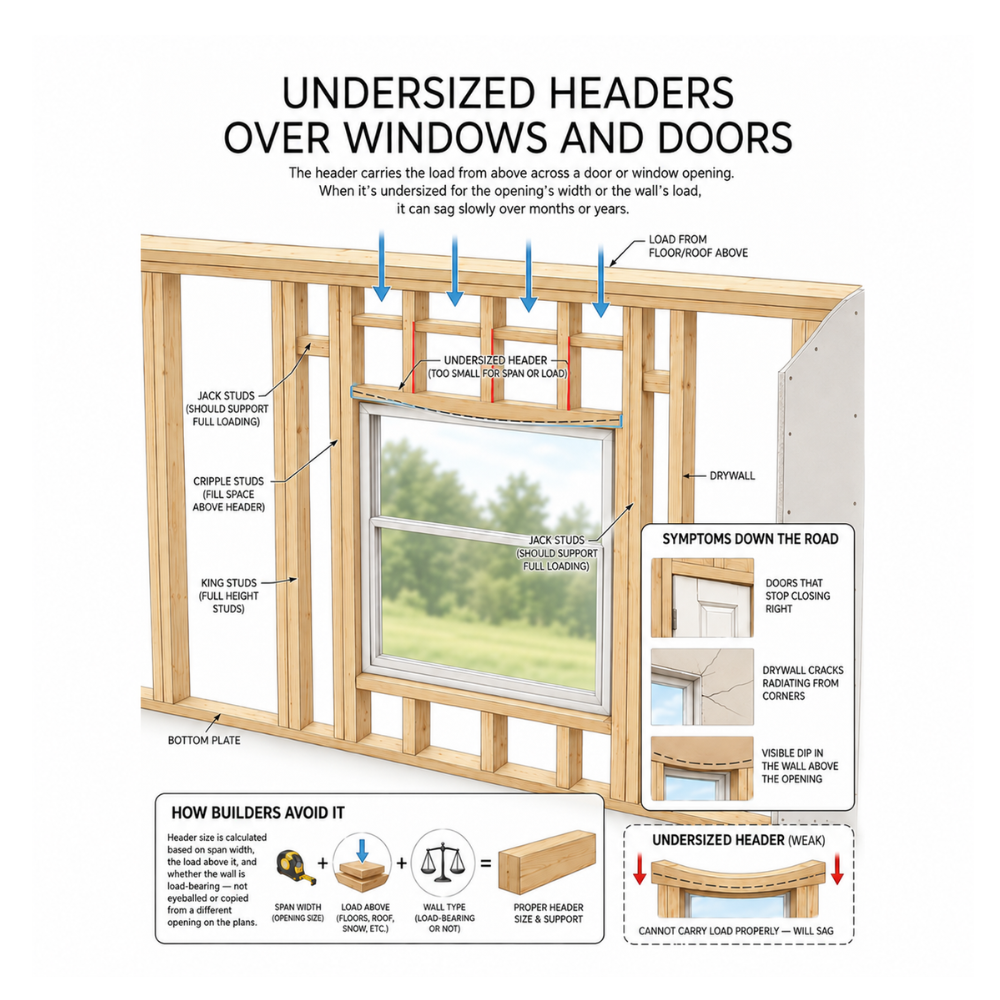
The header carries the load from above across a door or window opening. When it’s undersized for the opening’s width or the wall’s load, it can sag slowly over months or years.
Symptoms down the road: doors that stop closing right, drywall cracks radiating from the corners of windows, or a visible dip in the wall above the opening.
How builders avoid it: Header size is calculated based on span width, the load above it, and whether the wall is load-bearing — not eyeballed or copied from a different opening on the plans. Refer.IRC R602.7 Headers and local code requirement
3. Skipping Bracing or Structural Sheathing
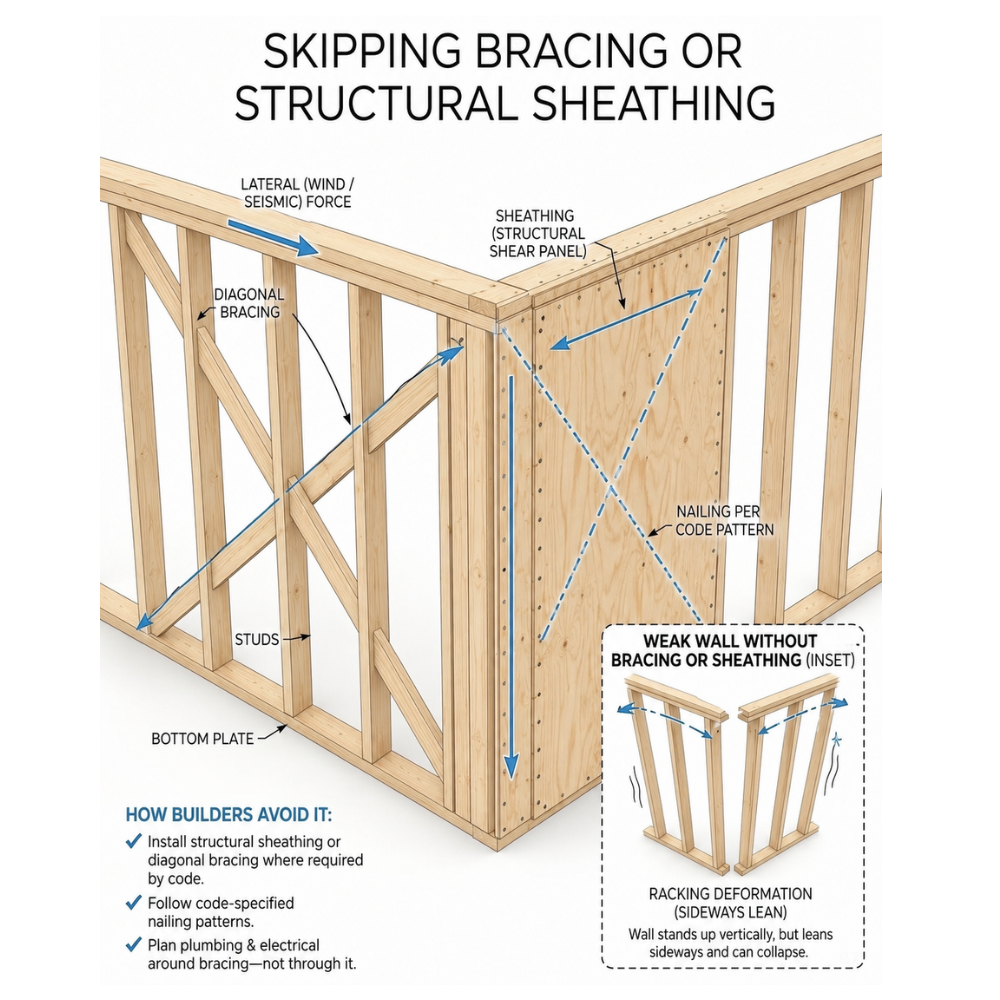
Walls need diagonal bracing or structural sheathing to resist racking — the sideways lean that happens under wind or seismic load. Skipping it, or cutting it away later for wiring and plumbing, leaves the wall structurally sound vertically but weak laterally.
How builders avoid it: Sheathing is installed to code-specified nailing patterns, and any penetrations for utilities are planned around bracing rather than through it. Refer IRC R602.10 and local codes
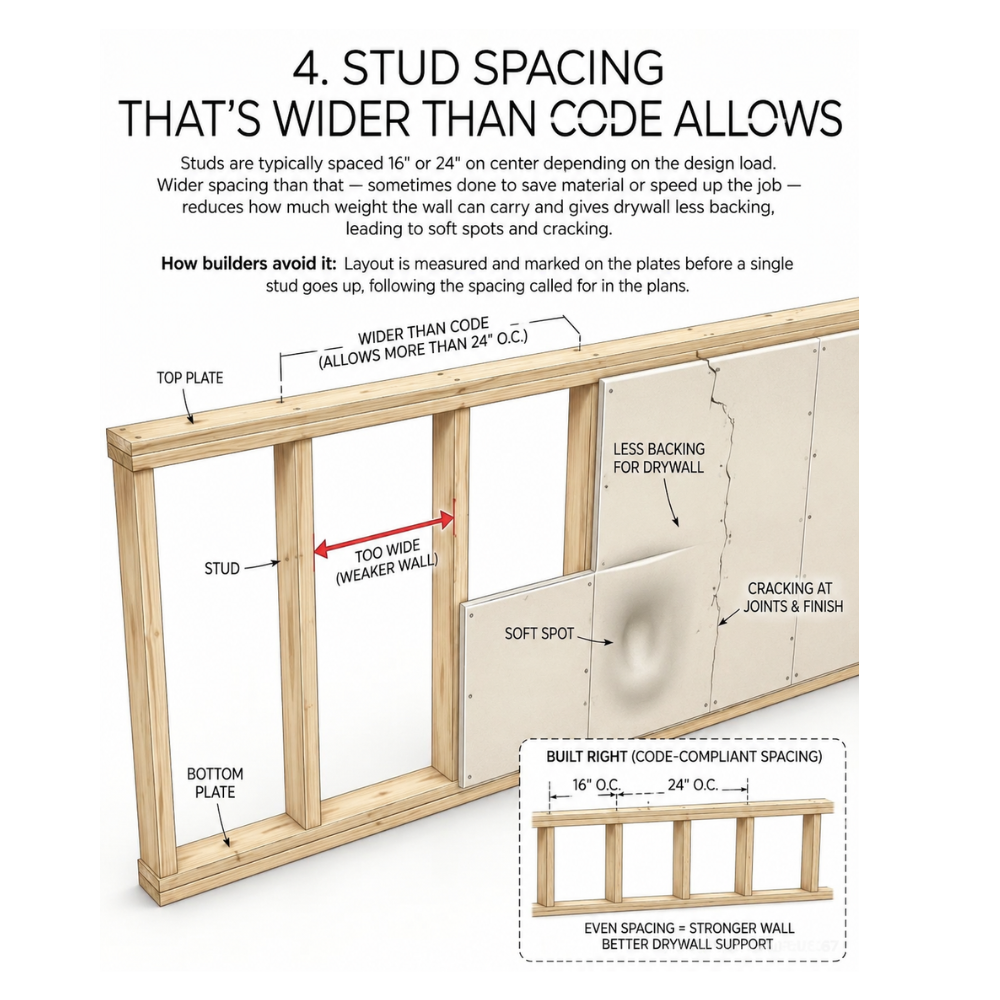
4. Stud Spacing That’s Wider Than Code Allows
Studs are typically spaced 16″ or 24″ on center depending on the design load. Wider spacing than that — sometimes done to save material or speed up the job — reduces how much weight the wall can carry and gives drywall less backing, leading to soft spots and cracking.
How builders avoid it: Layout is measured and marked on the plates before a single stud goes up, following the spacing called for in the plans.Refer IRC R602.3.1 and local codes
5. Over-Notched or Over-Drilled Studs
Running wiring or plumbing through studs is normal — but there are limits to how deep a notch or hole can go before it compromises the stud’s strength. A stud drilled too close to its edge, or notched too deep, can fail under load even though it looks intact.
How builders avoid it: Code sets maximum notch and hole sizes based on the stud’s dimensions, and electricians/plumbers are expected to work within them (or add reinforcing plates when they can’t).Refer IRC R602.6 Drilling and notching of studs and local codes
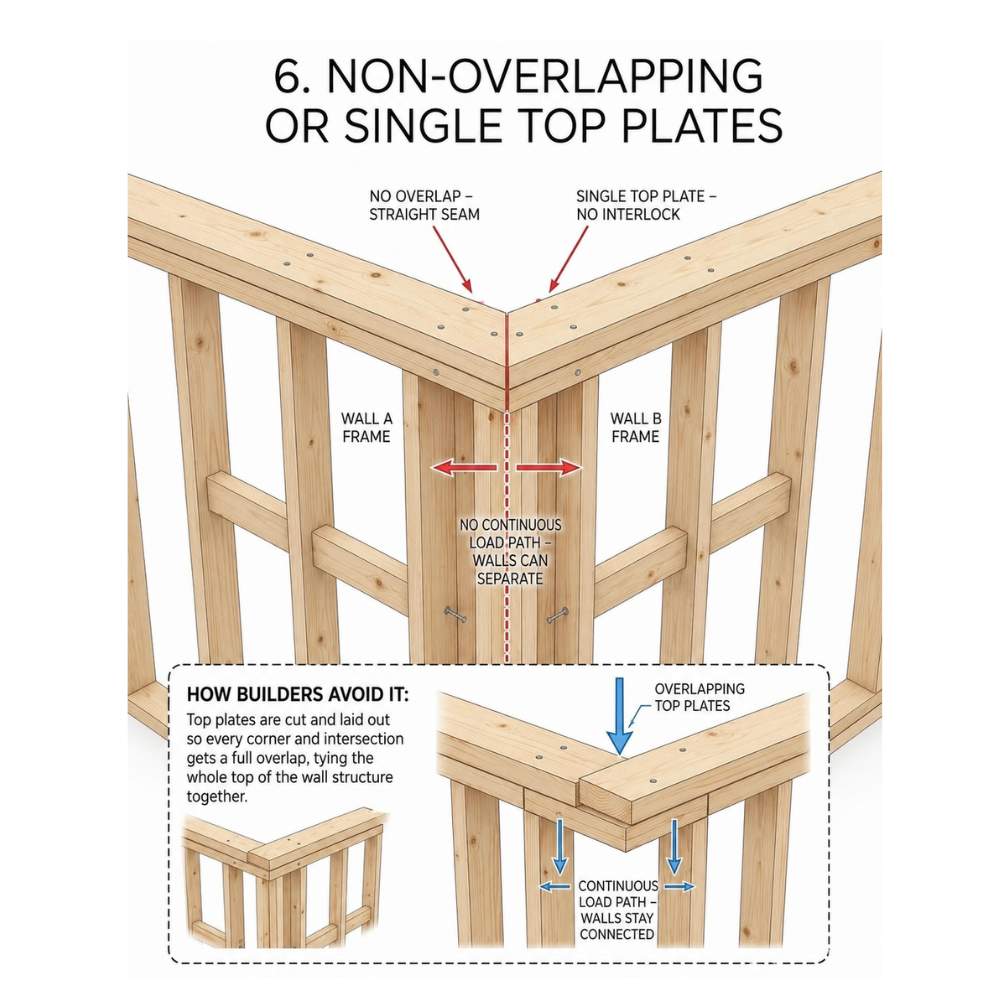
6. Non-Overlapping or Single Top Plates
Most walls use a doubled top plate, and at corners and wall intersections, the plates are staggered so they overlap into the adjoining wall. Skipping the overlap — or using only a single top plate — leaves a straight seam with no real connection between wall sections.
How builders avoid it: Top plates are cut and laid out specifically so every corner and intersection gets a full overlap, tying the whole top of the wall structure together (visible in the corner diagram above).IRC R602.3.2 Top plates must lap at corners and intersections and local codes
7. Poorly Anchored Bottom Plates
The bottom plate connects the entire wall to the foundation or floor below. If it’s not properly bolted, strapped, or sealed, it becomes a weak point — especially in high wind or seismic areas, where a poorly anchored wall can shift or lift.
How builders avoid it: Anchor bolts or straps are placed at code-required spacing, with a sill sealer or moisture barrier between the plate and concrete to prevent rot on top of the structural risk.IRC R403.1.6 Foundation anchorage / sill plate anchorage; IRC R602.11 or local foundation anchorage provisions where applicable.
8. Missing Jack Studs on Wide Openings
Jack studs (trimmer studs) hold up the header. A single jack stud might be fine for a narrow window, but wide openings — big picture windows, sliding doors, double doors — need multiple jack studs to carry the extra load without crushing or bowing.
How builders avoid it: The number of jack studs scales with the width of the opening and the load above it, following the header schedule in the plans rather than a one-size-fits-all approach.
IRC R602.7 Headers and opening framing; IRC R602.7.5 full-height studs at header ends
9. Using the Wrong Lumber Grade or Wet (“Green”) Lumber
Not all framing lumber is the same. Using a lower grade than specified, or lumber that’s still wet, can lead to warping, twisting, and shrinking after the wall is closed up — which shows up later as nail pops, cracked drywall, and uneven surfaces.
How builders avoid it: Framing lumber is specified by grade and moisture content on the plans, and good builders check both before it goes into the wall — not just whether the piece “looks straight.”IRC R602.1 General framing materials; IRC R502.1 and R602.1 material requirements
10. Inconsistent or Missing fastening Schedules
Every connection in a framed wall — stud to plate, sheathing to stud, plate to plate — has a required number, size, and spacing of nails or screws. Skipping fasteners to save time, or using the wrong size, quietly weakens every one of those connections at once.
How builders avoid it: Framing crews follow a nailing schedule specified in the building code or engineered plans, and inspectors check it before the wall is covered — because once it’s sheathed or drywalled, no one can see it again.IRC Table R602.3(1) Fastening schedule; IRC R602.3.2 top plate fastening; IRC R602.10 bracing fastening rules
The takeaway
Framing mistakes rarely announce themselves right away — that’s exactly what makes them dangerous.They show up years later as cracked drywall, sticking doors, or a wall that just doesn’t feel as solid as it should. If you’re building, ask your builder how they handle each of these details. If you’re buying, these are exactly the kind of things a good structural inspector should be checking before the drywall ever goes up.Always check local codes that are governing to be always consistent with local regulations.