
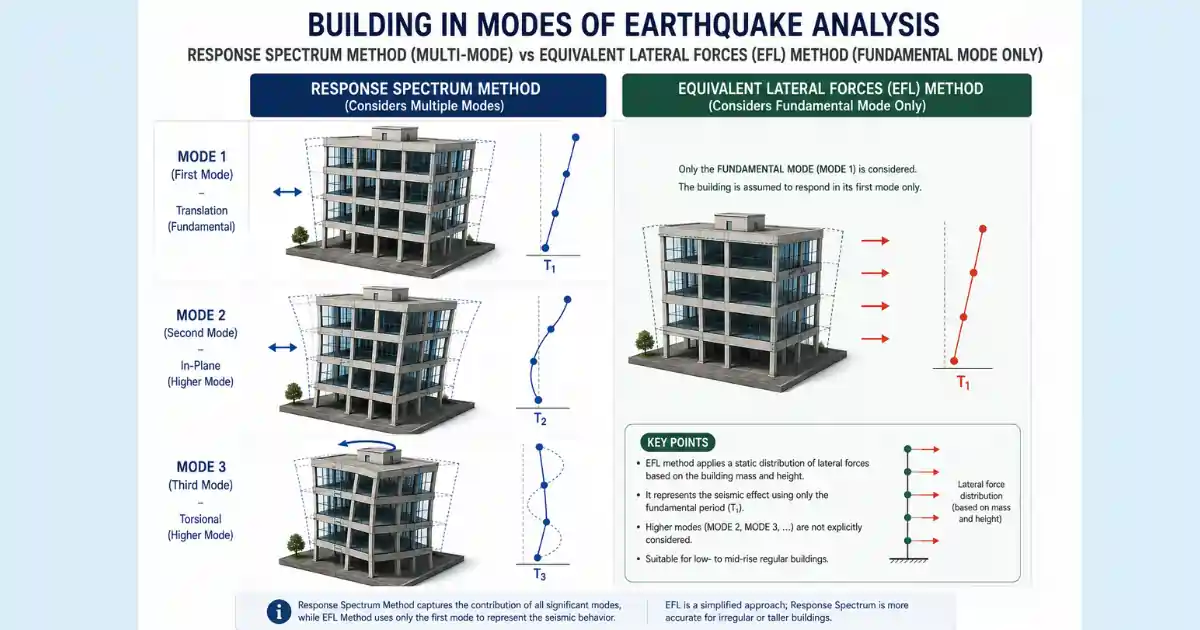
The value of the code’s estimate of a building’s period in Equivalent Lateral force method of earth quake design never quite matches what a detailed model analysis. But why is that? It’s actually done on purpose. The reason is the code estimate is derived from an empirical formula that is conservative by design. The reason why is that needed is explained beow.
Every building has a rhythm
Sway a flagpole and it whips back and forth quickly. Sway a skyscraper and it takes seconds to complete one full sway. That natural rhythm is called the building’s period — the time for one complete cycle of vibration. Short, stiff buildings have short periods. Tall, flexible buildings have long periods.
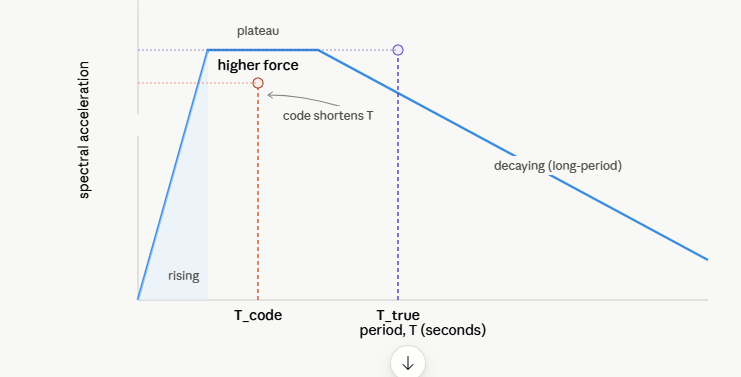
This matters enormously for earthquake design because of a chart every structural engineer knows by heart: the response spectrum. It plots how hard the ground shakes a building of a given period. For short periods, the curve shoots up steeply. It then plateaus, and eventually decays for long periods. Where your building’s period lands on that curve determines how much force it’s designed to resist.
The problem: nobody knows the real period in advance
Finding a building’s true period requires a full structural model and something called an eigenvalue analysis — real math, real computing time, and usually a design that’s already fairly developed. Early in a project, that’s overkill.
So codes offer a shortcut: a dead-simple empirical formula, using just height and structural system, that spits out an approximate period in seconds. This is what lets engineers skip straight to the Equivalent Lateral Force (ELF) method instead of running a full modal analysis.
Here’s the twist: that formula is deliberately calibrated to guess a period that’s shorter — stiffer — than the real building almost certainly is.
Why guessing “too stiff” is actually the safe move
Look back at that response spectrum curve. Short periods sit on the steep, rising part. So if the code’s formula assumes your building is stiffer (faster-swaying) than it probably really is, it lands you on a higher point of that curve — more assumed shaking, more calculated force, a stronger design.
That’s not sloppiness. It’s a deliberate safety margin. Since the simplified ELF method skips the rigorous math, the code compensates by nudging its only real input — the period — in whichever direction produces a bigger, more conservative answer. That built-in pessimism is the trade-off that lets you use the easy method and still trust the result.
In one line: codes intentionally assume your building is stiffer than it really is, which pushes the design onto the scarier part of the earthquake curve, buying the safety margin that justifies skipping the harder math.
So how does the “harder math” actually work?
Eventually — for taller or more irregular buildings — you do need the real answer. That means an eigenvalue extraction as shown in the following simple illustrative example. It sounds intimidating, but the core idea is something you can do by hand for a simple building.
Step 1: idealize the building
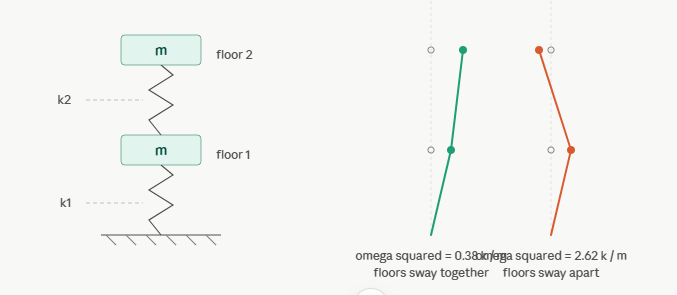
Picture the structure as lumped masses (the floors) connected by springs (the story stiffnesses). A two-story building becomes two masses, m, stacked on two springs, k1 and k2.
Step 2: write two small matrices
- Mass matrix: M = [[m, 0], [0, m]]
- Stiffness matrix: K = [[2k, -k], [-k, k]]
Step 3: set up the eigenvalue equation
(K – ω²M)φ = 0 only has a real solution when the determinant of (K – ω²M) is zero. Grinding through that determinant for our simple building gives a small quadratic:
λ² – 3λ + 1 = 0, where λ = ω²m/k
Solving it: λ = 0.382 or λ = 2.618 — golden-ratio numbers, a neat feature of this particular symmetric setup.
Step 4: read off the two periods
- Mode 1 (ω₁² = 0.382 k/m): the slow, gentle sway — this is the mode that dominates a real building’s response.
- Mode 2 (ω₂² = 2.618 k/m): a much faster, whip-like sway.
Step 5: find the mode shapes
Take just one row of the matrix equation, divide through by k, and you get a strikingly simple relationship:
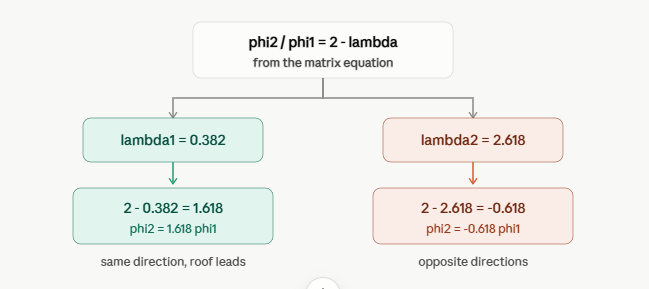
φ2/φ1 = 2 – λ
Plug in each λ you already solved for:
- Mode 1: 2 – 0.382 = 1.618 → the roof moves 1.618× as much as the base, same direction. This is the classic fundamental mode — the whole building leaning one way together.
- Mode 2: 2 – 2.618 = -0.618 → the roof moves 0.618× as much as the base, but opposite direction. The floors are pulling against each other.
That’s the entire mode shape calculation for a two-floor building: one small matrix, one quadratic equation, one substitution.
Why mode 1 gets called “the fundamental mode”
Codes like the Equivalent lateral force method consider only the first mode in seismic analysis. This period with which the first mode vibrates is called the fundamental period. It’s worth pausing on why mode 1 isn’t just “mode number one” — it’s physically special, and the name reflects that.
Think of a jump rope. The easiest way to shake it is one big arc, both ends fixed, the whole rope swinging as a single hump. You can also shake it into a shape with a wiggle in the middle — two humps, with a fixed point in between that doesn’t move at all — but that takes more effort and a faster shake. The single-hump shape is the fundamental mode; the two-hump shape is the next one up.
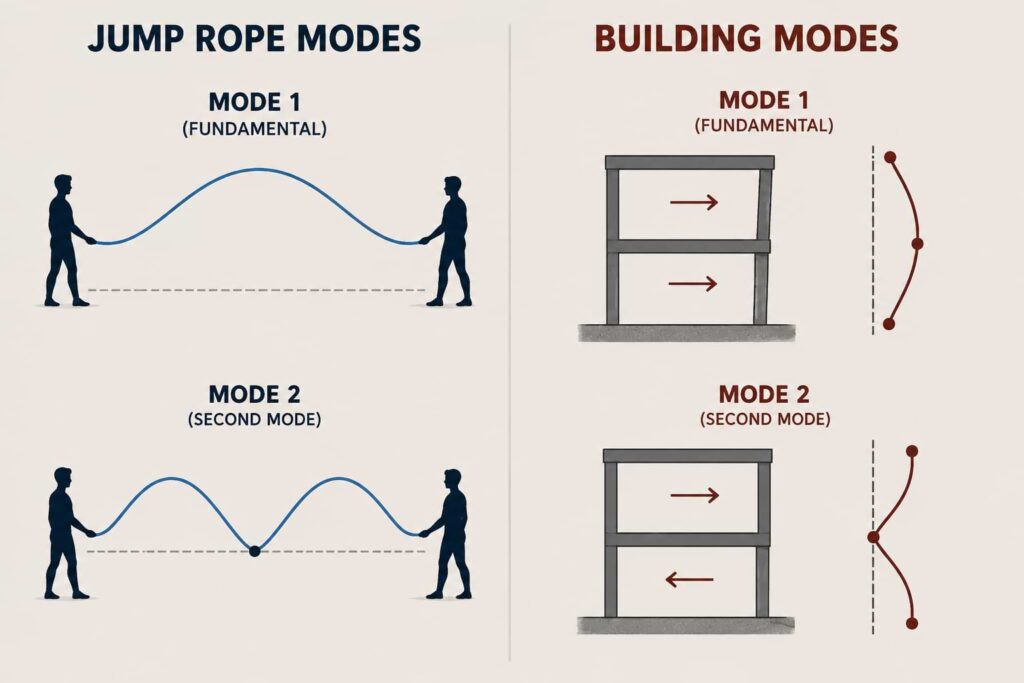
The same logic applies to the building. In mode 1, both floors move in the same direction — there’s no point along the height where the displacement crosses zero. It’s the simplest possible deformed shape the structure can take, and simplest means lowest stiffness resistance, which means lowest frequency and longest period. That’s exactly the smaller of our two values, ω₁² = 0.382 k/m.
Mode 2 forces the floors to move in opposite directions, which means there’s a point between them that doesn’t move at all — a “node.” Bending the structure into that shape fights more of the springs’ stiffness at once, so it takes more energy and happens faster: the higher ω₂² = 2.618 k/m.
A few reasons “fundamental” is the right word, not just the first number in a list:
- It’s what the building actually does when it sways. Watch a real building move in an earthquake or strong wind, and you’re watching mode 1. The higher modes exist mathematically but contribute far less to the total motion in most regular buildings.
- It has no nodes. Every point moves the same direction — the only mode shape with zero internal sign changes. Mode 2 has one node, mode 3 in a taller building would have two, and so on. Fewest nodes means fundamental; most nodes means highest.
- It dominates the seismic response. Real earthquake ground motion tends to shake structures most effectively near their fundamental period, which is part of why that single number is the most important one in a seismic design — and exactly the mode the empirical code formula from earlier is trying, conservatively, to estimate.
So when engineers say “the period of the building” without qualification, they almost always mean the fundamental period: mode 1’s period, because it’s the one that matters most and moves the most mass.
Why this all matters together
The empirical code period formula and the eigenvalue analysis are two ends of the same spectrum of effort. The formula is a quick, deliberately conservative guess that lets you skip the math on simple, regular buildings. The eigenvalue analysis is the real thing — the actual periods and mode shapes a structure will experience, found by solving the physics directly rather than approximating it.
Real buildings have as many modes as they have floors, and the matrices get large fast — which is exactly why software takes over for anything beyond a textbook example. But conceptually, a 40-story eigenvalue analysis is doing nothing more sophisticated than what we just did by hand for two floors: build M and K, solve for ω², and read off the mode shapes.